Look me in the eyes:
John Lennon vs Richard Nixon
 |
| Imagine... John Lennon met Richard Nixon |
For some years Richard Nixon played
a major role in John Lennon's life. Nixon could do with Lennon whatever he wanted
to do, like a puppet on a string. Yet he was afraid of the ex-Beatle. While
they look so much alike! And then there's that third person who makes this intrigued triangle complete.
By Dominique
Verschuren
John Lennon
In 1966, John
Lennon said the
Beatles were more popular than Jesus
Christ. Besides burned
Beatles records and
threats of the Ku Klux Klan, Lennon
got the dubious
honor of his own
FBI file. From the establishment of the FBI in 1924
the zealous director
J. Edgar Hoover tried to ensure the state
safety as much as possible to
collect information of any
suspicious person. Lennon's
file was not so
special, half Hollywood was stored in Washington.
In October 1968,
Lennon was arrested for drug possession. An
arrest which brought him in trouble later when he wanted a permanent residence permit for the United States.
This drug possession was supposedly the
official reason why the U.S. authorities wanted
him out of the country in 1972. Of course there
was more behind it.
Around 1971 he
was no longer that peace guru who laid in bed
for world peace only two years before. More
and more he began
to exchange the soft,
utopian ideals for
the fierce activism on the streets. Was he doubting about a
revolution in 1968 on Revolution, in 1971 he was clear: "Say
we want a revolution
/ We better
get on right away
/ Well you get on your feet / And out
on the street / Singing
power to the people." So Lennon was
more than ever before in the spotlight of Washington. A demonstration in the
capital was graced with the
slogan "All we are saying is ... get Nixon's ass"
on the familiar
tune of Give Peace A Chance.
In August of
that year, John and Yoko went to the United States. Forever. That
was the plan.
 It's clear that Richard Nixon
was definitely one of John Lennon's butts. Maybe
he was more concerned about Vietnam or the corrupt
system, but Lennon used Nixon's name directly to
subside his anger. In Gimme Some Truth: "No shot haired
- yellow bellied
son of tricky dicky."
We're All Water on the political record
Some Time In New York City: "There
may be not much
difference / Between Chairman Mao and Richard Nixon / If we strip them naked."
On the cover you can find a photographs
of a naked dancing
Nixon and Mao, Photoshoped
avant-la-lettre. A successful joke
which ridiculed Nixon.
It's clear that Richard Nixon
was definitely one of John Lennon's butts. Maybe
he was more concerned about Vietnam or the corrupt
system, but Lennon used Nixon's name directly to
subside his anger. In Gimme Some Truth: "No shot haired
- yellow bellied
son of tricky dicky."
We're All Water on the political record
Some Time In New York City: "There
may be not much
difference / Between Chairman Mao and Richard Nixon / If we strip them naked."
On the cover you can find a photographs
of a naked dancing
Nixon and Mao, Photoshoped
avant-la-lettre. A successful joke
which ridiculed Nixon.
Also U.S. government saw that in December 1971. Four
months after Lennon had settled in
the United States, he joined New Left activists
like Jerry Rubin and Abbie Hoffman. On 10
December he performed at a
concert for John Sinclair. Sinclair was
the leader of the White Panther
Party and was sentenced
to ten years for selling two joints. A few days
after the concert Sinclair was a free man. A sign of Lennon's influence on
public opinion? A week later,
the former Beatle played a benefit
concert for the victims of the
riots at Attica Prison
three months earlier.
But that was only the
start, according to an FBI agent: "February
1972, a confidential
source who has furnished
reliable information in the past, advised
that Lennon had
contributed $ 75,000 to a newly Organised New Left group,
formed to disrupt
the Republican National Convention."[0] Not only financially he
supported the opponents of Nixon.
John and Yoko jumped
on the car across the country. It would be a kind of political Woodstock crossing the United
States, eventually ending in August in San
Diego. There would
Nixon officially chosen
as the Republican candidate for the presidential election
in November.
John Lennon was
undoubtedly politically active in this
period. Wiener: "Of
course nobody wants to be a "politician ",
but John, in
seeking to mobilize
people against Nixon,
was certainly doing
politics." [1] Jerry Rubin: "John
was more radical
than I was in this
period. (...) He
was angry, really angry. He ranted and raved about the police.
(...) He was not
political in the sense
of being a planner
- but emotionally,
in his gut
reaction, he was
very radical: "It's us versus them. '"[2]
The idea of rock 'n'
revolution circus across America was soon
abandoned. The Department
of Immigration and Naturalization wanted to
deport Lennon. Based on his British arrest for
drugs in 1968. He was
being spied and his phone was tapped. Lennon: "Guys
would always be
standing on the street opposite. If I got
into a car they'd
get in cars and follow
me blatantly. They
wanted me to know
I was being
followed."[3] The day after he
had told this story on television, the threats stopped. But Lennon was warned.
Richard Nixon
So far Lennon's
side of the story. Why did Richard Nixon hunt
the ex-Beatle?
The answer is contained in the character of Richard Nixon. "A neurotic insecure
and therefore power-hungry man who had no feeling
for what was decent and what not in politics." Thus America expert Maarten van Rossem. "From the first months of his first term, he deliberately
lied, polarized and
tried to undermine the democratic
process. All this because he
felt insecure and threatened, even once he was
president. It seemed as if his
power could never be large enough
to take his fears away."[4]
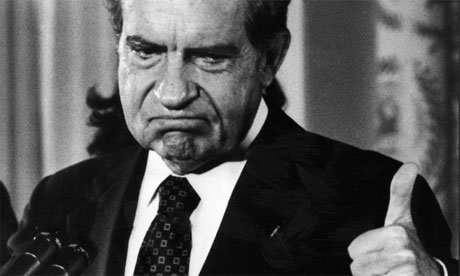 Despite (or
perhaps because) he was the most
power full man, Nixon saw himself
always as an
outsider. He trusted no one and
almost everyone was for him a political enemy.
In the White House circulated a blacklist with people
who get caught, spying or had to be made suspicious. From the spring
of 1971 Nixon
took every effort to be re-elected in 1972.
Beside that the secret bombing of Cambodia were leaked
and to be read on front page of The New York Times. To avoid those
kinds of leaks, the
so-called Pentagon Papers, and other opposition,
his staff asked people to install listening devices at strategic
locations. They committed also other
illegal activities. On 17 June 1972 some of those
employees were caught in the headquarters of the Democratic Party,
the Watergate building.
Despite (or
perhaps because) he was the most
power full man, Nixon saw himself
always as an
outsider. He trusted no one and
almost everyone was for him a political enemy.
In the White House circulated a blacklist with people
who get caught, spying or had to be made suspicious. From the spring
of 1971 Nixon
took every effort to be re-elected in 1972.
Beside that the secret bombing of Cambodia were leaked
and to be read on front page of The New York Times. To avoid those
kinds of leaks, the
so-called Pentagon Papers, and other opposition,
his staff asked people to install listening devices at strategic
locations. They committed also other
illegal activities. On 17 June 1972 some of those
employees were caught in the headquarters of the Democratic Party,
the Watergate building.
John Lennon was no
exception in Nixon's policies. Wiener: "None
of the documents that has been released
was sent to or from Richard Nixon himself. But Nixon's chief of staff, H.R.
Haldeman, was kept informed about the progress of the FBI's campaign to
'neutralise' Lennon."[5]
It was so normal during Nixon's tenure that the
president probably just note that decision. Yet
there is a special reason why
Lennon was so dangerous for the President.
For the first time in history eighteen
years old youngsters got the right to vote. This resulted
in an additional twelve
million new votes. The previous years were the worst in history since
the American Civil War over a hundred years earlier. The assassinations of John
and Robert Kennedy, and Martin Luther King, the Civil Right Movements
and the Vietnam War divided the country to the bone. The counterculture, largely
represented by baby
boomers who were born after World War II, grew steadily. Nixon did
not hesitate to November 1972. After his resounding
victory from one day to the other
he stopped troubling Lennon. (The Naturalization Service Lennon would still
continue to fight until 1975 when they verdict in Lennon's favor.)
Had Nixon reasons
to fear Lennon's political
influence or was he again float by his paranoia?
We will never know. Now, more than forty
years later, the tendency to
relativize John's influence is very large. Then, in the late sixties and early seventies, it looked differently according the
established order. Wiener: "In 1969, Time
magazine wrote that rock was 'not just a particular form of pop, but... one
long symphony of protest... basically moral... the proclamation of a new set of
values... the anthem of revolution'. The underground press never made a
stronger claim. For once, Nixon wasn't being paranoid - or at least his
deliriums were shared by others." [6] Lennon was cool, Nixon
wasn't. Nixon was
the establishment, good enough to be kicked. Dan Richter: "(John) had only to say 'yes'
and he could speak to millions of viewers
on primetime. We did not feel we belonged
to the underground or outsiders. We
represented the reality, the
politicians, the military and the people that John
wanted to kick him out the country were living in a fantasy world alive."[7]
Nixon abused
his power on a large scale. Moreover the struggle of a lonely man against a whole
bureaucratic apparatus speaks to our
imagination. David against
Goliath, as you can indicates from the evocative
documentary title The
U.S. vs. John
Lennon. That doesn't mean that Lennon, at the height of
his fame and only three years
after he lied worldwide on television in bed for peace, certainly
could have made a difference. But Nixon won in
1972 with such an overwhelming majority[8] of the democratic opponent McGovern
that it is unlikely that Lennon could changed
that.
David Frost
Nixon was paranoid,
insecure and burdened with an inferiority complex. Nixon was a pit bull who
never gave up. Like pearls
in the mud his victories shine alongside a preponderance
of political defeats. Portraits of him giving
an image of a wronged man who often referred
to his humble origins. He was raised by a domineering mother who gave him little
affection and "a little man," as Richard
his father always described. In the background the ruthless Quaker Faith.
In Oliver Stone's film Nixon Kissinger says: "Can you imagine
what this man would have been, if he'd ever been loved. It's a tragedy, because
he has greatness." Someone with more subtle
sense for what's going
on around him would put a good face on the matter; Nixon
continued to deny that he had anything to do with Watergate. Even though John
Lennon and Richard Nixon were two complete different
personalities, not without reason diametrically opposed to each other, they also had things
in common: a persistent craving for
confirmation, because in the core they never got the recognition from whom they needed most.
As always, even
though they had reached the top, they keep staring to the "folks
on the hill". For both,
it was never enough.
 |
| David Frost meets John and Yoko |
After a play
they also made a film: Nixon/Frost is a bit romanticized, but the core of the interview remained. In an imaginary
scene Nixon calls
Frost late in the evening. And then follows:
Nixon: "Did the
snobs there (Cambridge University) look down on you, too? Of course they did.
That's our tragedy, isn't it, Mr. Frost? No matter how high we get, they still
look down at us."
Frost: "I really
don't know what you're talking about."
 |
| David Frost confronts Richard Nixon |
Nixon: "Yes, you do. Now, come on. No matter how many awards or column inches are written about you or how high the elected office is for me, it's still not enough. We still feel like the little man, the loser they told us we were a hundred times. The smart-asses at college, the high-ups, the well-born, the people whose respect we really wanted, really craved. And isn't that why we work so hard now, why we fight for every inch, scrambling our way up in undignified fashion? (...) We were headed, both of us, for the dirt! A place the snobs always told us that we'd end up. Face in the dust. Humiliated all the more for having tried so pitifully hard. Well, to hell with that! We're not gonna let that happen, either of us. We're gonna show those bums. We're gonna make them choke on our continued success, our continued headlines, our continued awards and power and glory! We are gonna make those motherfuckers choke! Am I right?
Frost: 'You are.
Except only one of us can win."[9]
John Lennon
can only responds with one answer.
He sings in
Working Class Hero: "As soon as you're
born they make you feel small/ By giving you no time instead of it all/ Till
the pain is so big you feel nothing at all." In the first five years of
his life Lennon was rejected by his mother and father. He was in the war, his
mum was lovely but too young to play a mother. She went out dancing while
little John was screaming in his bed. She brought men home which made the
sensitive boy even more jealous and insecure. When he was five years old John
was taken by his father for a holiday in Blackpool. He had the time of his
life. But shortly his mother Julia came. The parents argued about their son. In
the end they asked him to choose: his mother or father. John choose his father,
Julia disappeared and John started to panic. He ran to his mum and she took him
with her back to Liverpool.
During the interview with
Frost Nixon admitted he had made
mistakes: "I let the American people down. I have to carry that burden with
me for the rest of my life."[10] Unprecedented for someone
who was known as uncompromising.
Millions saw the
close up of the face of someone who was signed
by his own legacy. Just like John
Lennon David Frost understood the power of the media.
But those two British men
had more in common: they fought
their way to the top starting from a feeling of inferiority. And as
a curious triangle they had also much in common with their striking opponent:
Richard Nixon, an
empty shell which stood as alienated to himself as John Lennon did.
Even though they were respectively the most
powerful person on the planet
and one of the four most beloved young men of
modern culture. Although there
was a world of difference between
them, when Richard Nixon and John Lennon looked
at each other, they looked in a
mirror.
[0] Phil Strongman, John Lennon. Life, Times & Assassination, p. 153.
[1] Jon Wiener, Come Together.
John Lennon In His Time, p. 129.
[2] Jon Wiener, Come Together.
John Lennon In His Time, p. 178.
[3] Phil Strongman, John
Lennon. Life, Times And Assassination, p. 155.
[4]
Maarten Van Rossem, De Verenigde Staten In De Twintigste Eeuw, p. 277.
[5] Jon Wiener, John Lennon versus the
FBI, in: Elizabeth Thomson and David Gutman ed., The Lennon Companion. Twenty-Five Years Of Comment, p. 194.
[6] Jon Wiener, John Lennon
versus the FBI, in: Elizabeth Thomson and David Gutman ed., The Lennon Companion. Twenty-Five Years Of Comment, p. 195.
[7] Philip Norman, John Lennon. De
Definitieve Biografie, p. 724.
[8] 46, 7 million people voted for Nixon, 28, 9 miljoen for McGovern. Percentage: 61,8 against 8,2. That means: 520 electors for Nixon, only 17 for McGovern, a historical victory. More details: http://nl.wikipedia.org/wiki/Uitslagen_Amerikaanse_presidentsverkiezingen
[9] Frost/Nixon dvd, 1h 18 min 36 sec.
[10]
http://www.youtube.com/watch?feature=endscreen&NR=1&v=PkcZAB4_wd4 (8
min 05 sec)


